





PhilHealth EPRS employer update: What version 4.9.0 changes from October 1, 2026
Stay compliant with PhilHealth EPRS Version 4.9.0. Discover how to unlock the new online payment


Payroll mistakes are rarely just payroll mistakes. A missed remittance, an inaccurate overtime computation, or a delayed payroll run can quickly become compliance issues, employee concerns, and management escalations that are far harder to resolve than the original error.

Managing performance reviews manually is costing your HR team time, accuracy, and compliance. In this live demo, we’ll walk you through Sprout Perform — the performance management module built for Sprout HR and designed for audit-ready appraisals.
As PhilHealth expands its primary care coverage through the YAKAP (Yaman ng Kalusugan Program), HR teams have a meaningful opportunity to enhance the health support they provide to employees.
Employee offboarding outgrows a spreadsheet once HR is managing several exits at the same time. At that point, HR can no longer see in one place which clearance tasks are done, which are stalled, and whose final pay is nearing the legal deadline.
In the Philippines, that deadline is fixed. Under DOLE Labor Advisory No. 06, Series of 2020, final pay is due within 30 days of separation, and a Certificate of Employment is due within three days of a request. A structured offboarding workflow gives HR, IT, Finance, Facilities, and managers one shared view of every exit, so each handoff is tracked and every deadline stays visible.
Offboarding is easy to underestimate because it happens at the end of the employee lifecycle. But when someone leaves, HR may need to coordinate clearance, access removal, equipment returns, payroll, employee records, and exit documentation across several teams.
Employees can leave at any point, so offboarding can quickly become a regular process for HR teams. The Work Institute’s 2025 Retention Report, based on U.S. exit interview data, found that as much as 40% of employee turnover occurs within the first year. In 2024, work-life balance accounted for 15.1% of first-year turnover.
A spreadsheet may work for a few exits, but as more employees leave, it gets harder to track what is complete, what is delayed, and who still needs to act.
Employee offboarding is the process of formally separating an employee from an organization, whether through resignation, termination, end of contract, or retirement. In the Philippines, it typically covers departmental clearance, return of company property, removal of system and facility access, final pay computation and release, issuance of the Certificate of Employment, and an exit interview.
For the legal side of separations, see Sprout’s guides to DOLE rules on employee resignation and employee termination in the Philippines.
A single employee exit is manageable. HR starts the clearance process, IT removes access, Finance handles final pay, Facilities checks company property, and the manager confirms any outstanding responsibilities.
But what if several employees leave at the same time? HR now has multiple emails, forms, messages, and spreadsheet rows to track. One employee may be waiting for IT while another is waiting for Finance. Someone else may have finished clearance but still needs an exit interview.
Here’s a useful test. Ask, “How many exits are in progress right now, and which ones are overdue?” If answering means opening several files or messaging each department, your offboarding process has outgrown the spreadsheet.
Under DOLE Labor Advisory No. 06-20, final pay should generally be released within 30 days from the date of separation, unless a more favorable company policy or agreement applies. Employees should also receive a Certificate of Employment within three days of their request. DOLE reiterated these requirements in January 2026.
Key offboarding deadlines under DOLE Labor Advisory No. 06-20:
| Requirement | Deadline | Clock starts from |
| Final pay release | Within 30 days | Date of separation |
| Certificate of Employment | Within 3 days | Employee’s request |
HR should handle final pay carefully, as it’s one of the more common concerns raised by departing employees. In 2025, DOLE recorded 23,496 final-pay concerns through Hotline 1349, making it the most common labor standards concern among the 168,853 concerns received. Requests for a COE follow the same principle, and Sprout explains the process in its guide on how to request a Certificate of Employment.
For a breakdown of what final pay can include and how to calculate it, see Sprout’s complete guide to final pay in the Philippines.

As the number of exits increases, some parts of offboarding become harder to track manually.
IT, Finance, Facilities, HR, and managers may each handle part of the process. If one person misses a task, the delay may not be noticed until someone checks the spreadsheet again.
Employee access to systems, applications, and facilities needs to be removed as part of the exit process. When this depends on email reminders, tasks can easily be missed or delayed. The exact steps vary by organization, but the process should make it clear who owns each task and whether it is complete.
Clearance and final pay often run in parallel. Finance may need clearance sign-offs before it can finalize deductions for unreturned property or outstanding loans. The 30-day period is counted from the date of separation, so HR needs to know which exits are approaching their deadline and which clearance tasks are still open. Employees are expected to complete clearance promptly, and employers are expected to release final pay without unnecessary delay.
Exit interviews can help HR understand why employees leave, but response rates can suffer when forms and follow-ups are handled manually. Sprout’s exit interview best practices for Philippine HR leaders covers how to get candid, usable feedback.
This feedback becomes more useful when HR looks at it alongside the rest of the employee lifecycle. SHRM notes that onboarding, unlike orientation, can last up to 12 months. Looking at onboarding and offboarding together can give HR a better view of what employees experience throughout their time with the organization. (Related: why onboarding matters for retention.)
With a structured offboarding process, every employee exit has a clear set of tasks, owners, and deadlines. HR can see where each exit stands without chasing updates across emails, messages, and spreadsheets.
| Offboarding task | Typical owner |
| Employee and separation details, including effective date | HR |
| Clearance by department | Each department head |
| Return of company property (laptop, ID, keys, equipment) | Facilities and IT |
| Removal of system and facility access | IT |
| Final pay computation and release | Payroll or Finance |
| Certificate of Employment and other required documents | HR |
| Exit interview | HR |
| Handover of ongoing work | Manager |
HR should be able to see what has been completed, what is still pending, and who needs to act next. If IT still needs to remove access or Finance is waiting for clearance, the status is visible without checking with each team.
Sprout HR’s Command Center includes an Offboard workflow that brings employee exits and clearance tasks into one place.
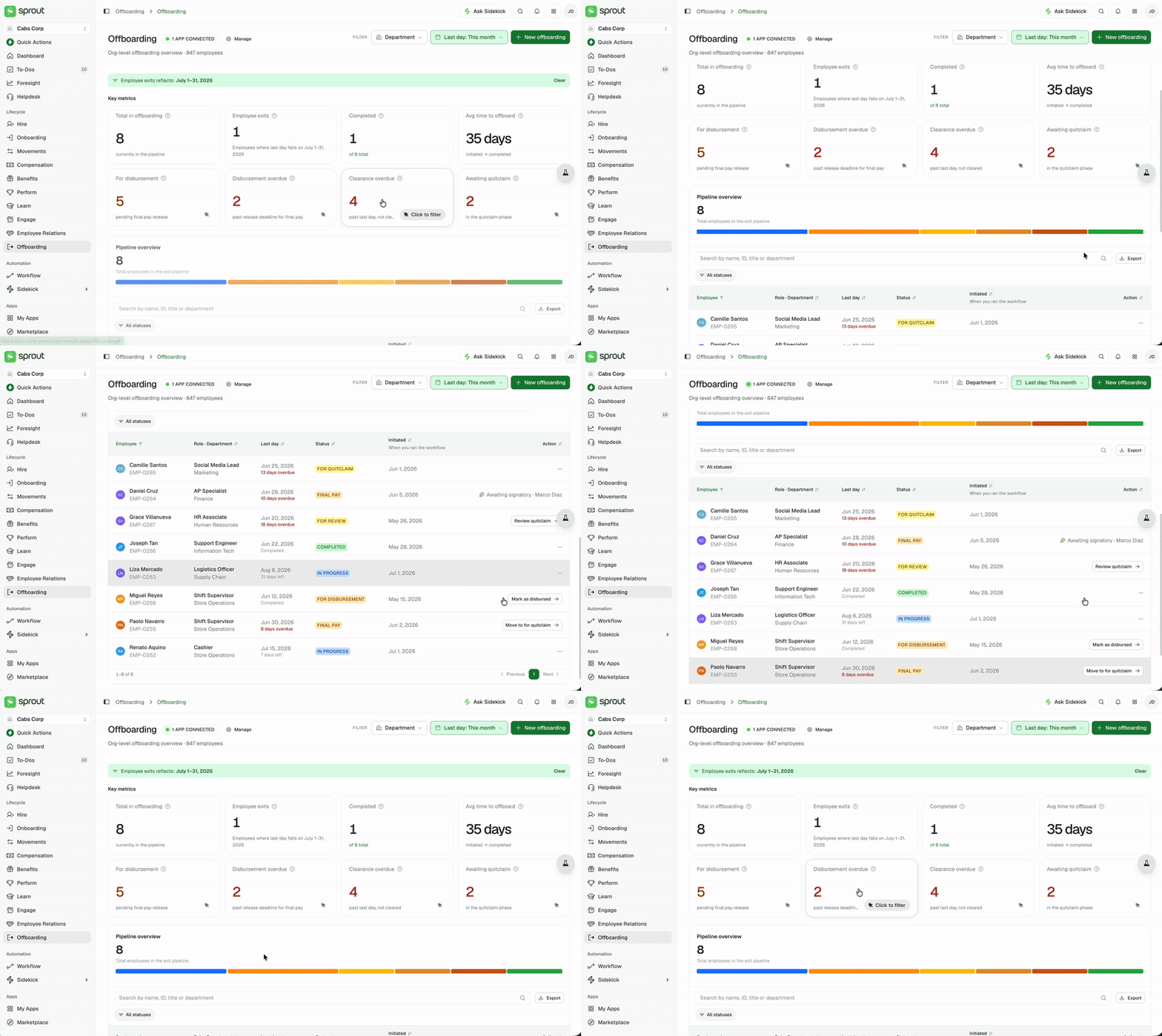
HR gets one queue showing clearance status for every exit across departments and sites. HR can track the status of each step without maintaining separate spreadsheets for different teams or locations. This makes it easier to see what has been completed and what still needs attention.
Sprout HR also has a self-service exit process through a magic-link exit portal. Departing employees can submit their exit information and complete their exit interview directly, so HR does not have to send and track every form manually.
For HR teams, this means less time chasing status updates and more time resolving the exits that are actually at risk of missing a deadline.
An employee’s last day is only one part of the exit process. Payroll may still need to handle unpaid wages, prorated 13th-month pay, leave conversion, tax adjustments, separation or retirement pay where applicable, and other amounts based on the employee’s situation and company policies.
This is why offboarding and payroll need to stay connected. Sprout Payroll handles Philippine payroll processing, while Sprout HR manages employee information and HR processes. When both draw from the same employee records, Payroll works from current information instead of re-keying data from a spreadsheet.

When HR records details such as separation dates, reasons, tenure, department, location, and exit feedback, it becomes easier to spot patterns. If several employees from the same team leave within their first year and mention workload or management issues, that tells HR more than the overall turnover rate alone.
Because first-year exits can make up as much as 40% of turnover, the early employee experience is worth a closer look.
Onboarding and offboarding can help connect the two sides. Onboarding shows how employees enter the organization, while offboarding can provide clues about why some of them leave. For a broader view of what Filipino employees experience at work today, see Sprout’s State of HR 2026 Report: AI and the Filipino Workforce.
When offboarding involves multiple teams, deadlines, and payroll requirements, a structured process can make it easier to keep every exit on track. Sprout HR brings employee information, clearance, exit tasks, and self-service offboarding into one place, while Sprout Payroll keeps final-pay processing connected to the employee’s records.
Talk to the Sprout team to see how a more connected offboarding process could work for your organization.

Offboarding usually becomes harder when HR is handling several exits at once, especially across different departments, locations, and processes. If HR has to check several files or send repeated follow-ups just to find out where an exit stands, the process is already becoming difficult to manage.
At the very least, it should cover the employee’s separation details, clearance tasks, responsible teams, pending actions, company property, system access removal, payroll status, required documents, and exit interview.
Under DOLE Labor Advisory No. 06-20, final pay should generally be released within 30 days from the date of separation, unless a more favorable company policy or agreement applies. DOLE reiterated this requirement in January 2026.
Final pay covers all wages and benefits still owed to the employee. This includes unpaid salary, prorated 13th-month pay, cash conversion of unused leave, tax refunds, separation or retirement pay where applicable, and other benefits under company policy or agreements. See Sprout’s final pay guide for sample computations.
Under DOLE Labor Advisory No. 06-20, a Certificate of Employment should be issued within three days of the employee’s request. With Sidekick, employees can generate their Certificate of Employment within minutes, reducing the need for HR to manually prepare and process each request.
Employers may use a reasonable clearance process, for example to account for unreturned company property. However, the 30-day period under DOLE Labor Advisory No. 06-20 is counted from the date of separation, so clearance and payroll should move together. HR teams should confirm their clearance policy with legal counsel.
Yes, if the HR system supports self-service. Sprout HR’s offboarding workflow includes a magic-link exit portal where departing employees can submit information and complete their exit interview without needing regular access to the employee system.
HR can use exit interview data alongside turnover and employee lifecycle data to spot patterns. Looking at factors such as tenure, department, manager, location, and role can help show where certain issues may be recurring.
Stay compliant with PhilHealth EPRS Version 4.9.0. Discover how to unlock the new online payment
Sprout Solutions has launched Frontliner, an AI-powered operations platform that gives multi-location businesses in retail,

Learn how large Philippine companies can procure HR and payroll software without costly rollout risks.

Is your performance management process falling behind your growth? Discover 5 signs your reviews no